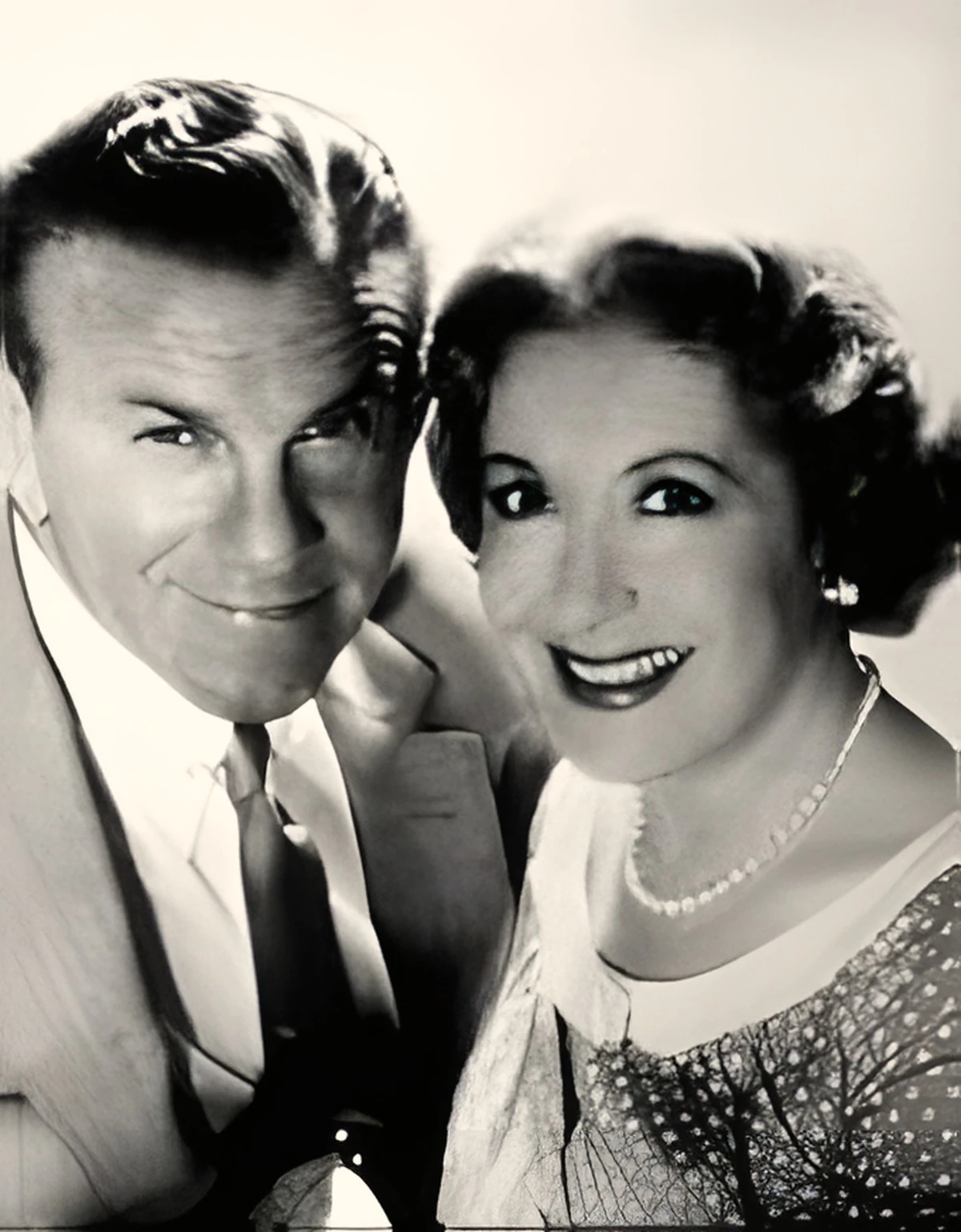
The Burns and Allen Show
How Two Vaudevillians Took Over the Air
The first thing to understand about the Burns and Allen Show is that it almost didn't happen. George Burns and Gracie Allen had already cracked the BBC during a vaudeville tour of England, using radio to pull crowds into their stage shows. Back in America, they auditioned for NBC and Grape Nuts in 1930, and an agency executive decided Gracie would be "too squeaky" on the air. They lost the job. A year later everything reversed course — and it reversed fast.
What changed was a single guest appearance. Eddie Cantor's program in the fall of 1931 was second only to Amos 'n' Andy in the ratings, and Cantor invited Gracie Allen to appear on it. The invitation, pointedly, did not include George Burns. Burns agreed on one condition: he would write her material. He stood at Gracie's side during the broadcast without saying a word and watched her steal the show from one of radio's biggest names. After that, Rudy Vallee had them on his Fleischmann Hour as a team. In February 1932, they were installed as comics-in-residence on the Guy Lombardo program for Robert Burns Panatella cigars — their first regular series — and a twenty-year radio run had begun.
Burns himself understood exactly what was happening and where the credit belonged. "The audience found her, I didn't," he said in a Playboy interview. He was being honest rather than modest. When he described Gracie as "a beautiful little girl, like a little doll, a little Irish doll," you could hear both the affection and the clear-eyed assessment of someone who had built a career around protecting and presenting something genuinely rare.
Where They Came From
Grace Ethel Cecile Rosalie Allen was born in San Francisco on July 26, 1905 — at least that was the date Burns supplied. Her actual birth year is disputed across census records, her high school yearbook, and her own jokes about a birth certificate destroyed in the San Francisco earthquake ("Well, it was an awfully big earthquake"). Her father, Edward Allen, toured with a song-and-dance act, and Gracie appeared onstage with him as a child. By age fourteen she was ready to quit school and become a performer. She and her sisters toured with the Larry Reilly vaudeville company until 1922, when she walked over a billing dispute. After that she took up stenography while rooming with friends on the fringes of vaudeville — keeping one foot in the world she intended to return to.
George Burns — born Nathan Birnbaum in New York on January 20, 1896 — had been working since age seven, when he sang in taverns and saloons as part of a schoolboys' group called the Peewee Quartet. The ninth of twelve children of Jewish immigrants from Galicia, he took his stage name around 1916, borrowing "George" from his admired older brother Izzy and "Burns" from the Burns Brothers Coal Company, whose product he and his friends had stolen to heat the family home. By the time he met Gracie he had been a trick roller skater, a dance instructor, a vaudeville comic, and briefly the husband of a dance partner named Hannah Siegel, whom he had renamed Hermosa Jose after his favorite cigar — a marriage required by her parents before she could tour with him, which lasted only as long as the tour.
He met Gracie when she accompanied her friend Rena Arnold to a theater in Union Hill, New Jersey, on an evening that turned out to be unusually eventful: Burns and Allen's first performance together was that night at the Hill Street Theater in Newark, they made five dollars per show, and the double date they went on afterward was with Gracie's friend Mary Kelly and Mary Kelly's new boyfriend, Jack Benny.
The act that emerged from that meeting flipped itself almost immediately. Burns had been the comedian, Gracie the straight man. Audiences made clear they preferred it the other way around, and Burns switched without apparent ego. He became the straight man, the slow-burn reactor, the man who could send Jack Benny into fits of laughter without saying a word — and who knew that if he blew a puff of cigar smoke in Gracie's direction, "the audience would hate me." They married on January 7, 1926, in Cleveland — a marriage considered bold for the times, given Burns's Jewish background and Allen's Irish Catholic upbringing. By 1927 they had signed a long contract with the Keith circuit at $750 a week. The 1940 Current Biography noted they had put in "hundreds of weeks of vaudeville" on the way up. By 1933, Burns recalled, Gracie was one of the five most famous women in America.
The Stunt That Made Them
Nothing illustrates how Burns operated better than the lost brother stunt. Launched on January 4, 1933, the scheme sent Gracie popping up unannounced on other programs — Eddie Cantor's show, Jack Benny's program, and others — claiming to be searching for her missing brother. The stunt ran across both networks simultaneously. There is some dispute about whose idea it was: Frank Buxton and Bill Owen, in The Big Broadcast, credited Bob Taplinger, head of publicity at CBS; writer Carroll Carroll believed it originated with Burns; and in one of his own books Burns said the idea came from the agency executives who wanted to promote the show's new timeslot. Whatever its origin, the J. Walter Thompson agency backed it and controlled enough programs on both networks to get it off the ground.
When NBC tried to shut the gag down, Rudy Vallee "accidentally" picked up the wrong script and mentioned it anyway. An NBC engineer cut the show off the air, generating a censorship controversy that only gave the stunt more press. Meanwhile Gracie's real brother — a publicity-shy San Francisco accountant named George Allen — had to go into hiding when reporters tracked him down. The Adventures of Gracie, as the show was then titled, catapulted into the top ten. The stunt was a piece of controlled chaos that demonstrated exactly how well Burns understood the mechanics of attention.
The Gracie-for-President campaign a few years later was the same instinct at larger scale. Gracie ran as a candidate from the Surprise Party — so named, the joke went, because her mother was a Democrat, her father a Republican, and Gracie herself a surprise. The campaign played out across roughly a dozen episodes of the Hinds Honey and Almond Cream Program on CBS in 1939–40, with an article under her byline in Liberty magazine titled "America's Next President Should Be a Woman," a small hardbound book attributed to "the Gracie Allen Self-Delusion Institute" and titled How to Become President, a kangaroo for a mascot, the slogan "It's in the bag," a whistle-stop train tour covering 34 cities, and a convention in Omaha drawing some 8,000 delegates. Eleanor Roosevelt invited her to the Women's National Press Club. Harvard students endorsed her. A Minnesota town offered her the mayoral job. The Surprise Party reportedly received several thousand actual write-in votes that November.
The Writing Behind the Laughter
Burns controlled the material with unusual precision. Carroll Carroll, who represented J. Walter Thompson on the show, wrote that Burns was "numero uno in thinking up what Gracie would say, should say, and could not say" on the air. Burns dictated final scripts to his secretary, Helen Schorr, line by line, the way each line should be said by Gracie. Writer John P. Medbury was paid by Burns specifically to think up and mail in weekly doses of Gracie-type gags. Carroll's own summary of what Gracie meant to the show was blunt: "Gracie without George would have been Irish coffee without the John Jameson."
The 1930s writing staff included Harry Conn — who Carroll called "a joker" who tried to get Carroll fired and soon left the show himself — alongside Medbury and Carroll himself. The later years brought in Paul Henning (who would go on to create The Beverly Hillbillies), Harvey Helm, Hal Block, Henry Garson, Keith Fowler, Aaron J. Ruben, Harmon J. Alexander, and Helen Gould Harvey. Directors over the full run included Ed Gardner, Ralph Levy, and Al Kaye, and Glenhall Taylor produced the show beginning in October 1941.
Gracie herself suffered from severe mike fright and never fully lost her fear of the microphone — a detail that makes the apparent effortlessness of her radio performances more striking. In 1939 she appeared on the intellectual quiz show Information, Please and held her own with the experts. Whatever anxiety she carried into the studio, it was not audible in the work. Burns's own description of what she did on the air was as precise as anything ever written about her: "The character was simply the dizziest dame in the world, but what made her different from all the other Dumb Doras was that Gracie played her as if she were totally sane, as if her answers actually made sense."
The Cast and Sound of the Sitcom Years
By January 1941 the show's rating had slipped to 14.8, and Burns announced a move to a situation comedy format in 1942. The change was structural as much as comedic: in the 1930s shows it was never mentioned that Burns and Allen were husband and wife, and Gracie's flirtations with bandleaders Ray Noble and Artie Shaw — Noble's running line was "Gracie, this is the first time we've ever been alone" — and guests like Charles Boyer, Tony Martin, and announcer Paul Douglas were treated as the central comic engine. The sitcom format threw that away and built a household. Each week opened with announcer Bill Goodwin introducing "the people who live in the Burns house, George and Gracie." The rating pushed back to 20 points.
The ensemble that accumulated around Burns and Allen in the 1940s was substantial. Bea Benaderet played neighbor Blanche Morton — a role she would carry through all 291-plus episodes of the television series, the only secondary cast member to appear in every one. Elvia Allman played Gracie's friend Tootsie Sagwell. Mel Blanc played "the Happy Postman," a character who sobbed his way through the cheeriest news. Clarence Nash played Herman the Duck. Margaret Brayton played Mrs. Billingsley, and Sara Berner played Muriel. Elliott Lewis played a recurring character encountered by Burns week to week in different jobs — usher, cab driver, and others — whose routine always began in bliss and ended in rage. The larger ensemble included Gale Gordon, Hans Conried, Richard Crenna, Joseph Kearns, Hal March, Gerald Mohr, Marvin Miller, Doris Singleton, Eric Snowden, Mary Lee Robb, Wally Maher, Dawn Bender, and Tommy Bernard.
Bill Goodwin announced from 1942 to 1950, with Harry Von Zell at various points and Tobe Reed serving as second announcer from 1947 to 1949. The orchestra chair changed regularly: Paul Whiteman in 1942–43, Felix Mills through 1945, Meredith Willson through 1948, Harry Lubin through 1950. The Sportsmen Quartet sang during the Swan Soap years under the name "the Swantet," supplying songs and occasionally backing vocalist Jimmy Cash. Sound effects were handled by Virgil Reimer on NBC and by David Light and Al Span on CBS. A surviving program from the late 1940s features Howard Duff turning up in character as Sam Spade.
The Long Network Journey
The show's network history is a catalogue of moves and sponsor changes over nearly two decades. The first regular run, on CBS from February 1932, was sponsored by Robert Burns Panatella cigars and built into the existing Guy Lombardo program. White Owl Cigars took over in May 1933. When Lombardo took his band to NBC in 1934, Burns and Allen were offered the entire half-hour at $2,000 a week and stayed on CBS as The Adventures of Gracie, which became The Burns and Allen Show in late 1936, with Campbell Soups as sponsor. The theme song "Love Nest" — composed by Louis A. Hirsch and Otto A. Harbach for the 1920 Broadway musical Mary — was adopted from the September 1934 run onward and would follow the act all the way into television. Orchestras during those CBS years included Ferde Grofe, Jacques Renard, Eddy Duchin, and Henry King, with Ken Niles announcing and Milton Watson then Tony Martin handling the vocal duties.
The show moved to NBC in April 1937 for Grape Nuts, then back to CBS in September 1938 for a Chesterfield Cigarettes run with announcer Paul Douglas and vocalist Frank Parker. Hinds Cream sponsored the 1939–40 CBS run; Hormel Meats took the 1940–41 NBC run with Artie Shaw conducting. Lever Brothers' Swan Soap came on for the NBC run beginning October 1941 and carried through the early sitcom years on CBS from 1942 to 1945. The NBC run from September 1945 through June 1949 ran under the title Maxwell House Coffee Time for General Foods, with Meredith Willson's orchestra as the musical anchor. Around 1948–49 Burns and Allen became part of CBS president William S. Paley's celebrated talent raid on NBC; Jack Benny convinced them, along with Red Skelton and Edgar Bergen, to follow him across, and the show landed on CBS in September 1949 as The Ammident Show, sponsored by Block Drugs and running through May 17, 1950. By the end of that run, radio income alone had at one point been estimated at $9,000 a week.
After Radio
When radio began to fade in 1950, Burns moved into television. The George Burns and Gracie Allen Show debuted on CBS on October 12, 1950, initially live and biweekly from the Mansfield Theatre in New York; by March 1953 it was a weekly filmed series airing Mondays at 8 p.m. behind I Love Lucy, and it cracked the Nielsen top thirty. Burns's innovation of stepping outside the plot to address the audience directly — a one-man Greek chorus standing apart from his own show — was among the first uses of the technique in American television. The sets were designed to resemble the couple's real Beverly Hills home, and establishing shots of the actual Maple Drive house were used on the air. The series ran eight years and earned eleven Primetime Emmy nominations.
Gracie Allen retired in 1958, and with her retirement the Burns and Allen partnership ended. She suffered a heart attack and died on August 27, 1964. Burns's solo television effort, The George Burns Show, folded within a year; a follow-up called Wendy and Me, starring Connie Stevens, met a similar fate.
What came after is well known. The role of Al Lewis in the 1975 film The Sunshine Boys had been written for Jack Benny, who became ill and could not take it; Burns stepped in and won the Academy Award for Best Supporting Actor at age 79, the oldest Oscar winner in Academy history at the time. He played the title role in Oh, God in 1977 and kept working at a pace that defied accounting. He wrote Gracie: A Love Story, a humorous, sad remembrance and testament of love. He died on March 9, 1996, at age 100, seven weeks after his hundredth birthday, and was interred beside Gracie at Forest Lawn. The crypt marker reads, "Gracie Allen (1902–1964) and George Burns (1896–1996) — Together Again."
More than a hundred Burns and Allen programs survive on tape, spanning the variety format of the 1930s and the domestic situation comedy of the 1940s. The act was inducted into the National Radio Hall of Fame in 1994 and the Television Hall of Fame in 1988, and the Alliance for Women in Media named its Gracie Awards in Allen's honor. What the recordings document is a partnership that lasted from vaudeville through radio's golden years — built on a clear-eyed division of labor, a writer's instinct for what an audience would believe, and a comedian who understood that the best thing he could do for the act was stay out of Gracie's way.